
The Temple
Jwalamukhi Temple in Kangra Valley, Himachal Pradesh, contains one of the most extraordinary natural phenomena at any temple in India — nine eternal flames that emerge from fissures in the rock and burn continuously without any external fuel source. These flames are natural gas vents from underground — but to devotees they are the nine forms of the Goddess: Mahakali, Unpurna, Chandi, Hinglaj, Bindhya Basini, Maha Lakshmi, Saraswati, Ambika, and Anji Devi. The Goddess here is "Jawala" (flame) — the tongue of Sati, which is said to have fallen at this spot. There is no idol — the flames themselves are the Goddess.

The Sacred Story

Nine eternal flames burn without fuel in the Himalayan foothills — the fiery tongue of the Goddess herself
The Epic Legend of Jwalamukhi: The Goddess of Eternal Fire
Jwalamukhi Temple is perhaps the most visually astonishing Shakti Peetha, where the Goddess is not worshipped as a stone idol, but as living, breathing fire.
Part 1: Mythological Origins (Sati's Tongue)
1. The Fall of Sati's Tongue (Jihva)
According to the foundational mythology of the Shakti Peethas, when Goddess Sati sacrificed herself in the sacred fire of her father Daksha's yagna, an inconsolable Lord Shiva carried her burning body across the universe. To stop Shiva's devastating Tandava (dance of destruction), Lord Vishnu used his Sudarshana Chakra to sever Sati's body into 51 parts.
It is believed that Sati's tongue (jihva) fell in the lush, green Kangra Valley. Because the tongue is the biological center of speech (Vak), this Peetha is intimately associated with the immense, universe-altering power of words, mantras, and the divine voice. Here, the Goddess's voice manifests not as sound, but as an eternal, consuming flame.
2. Emperor Akbar's Failed Test
One of the most famous historical legends of Jwalamukhi involves the powerful Mughal Emperor Akbar. Hearing tales of a Hindu temple where flames burned continuously without oil or wood, a skeptical Akbar visited the site in the 16th century. Determined to test—and disprove—the "miracle", he ordered his soldiers to forge a heavy iron disk across the flames and even had a stream of water channeled directly over the fire to drown it.
To the Emperor's absolute astonishment, the divine flames easily pierced the iron disk and continued to burn fiercely right through the rushing water.
3. The Transmuted Golden Canopy
Humbled by this sheer display of inexplicable power, Akbar accepted the Goddess's supremacy. As a magnificent royal offering, he presented a massive, intricately carved solid gold Chatra (canopy) to the Goddess. However, the exact moment the Emperor proudly placed the gold canopy over the flames, the Goddess rejected his arrogant display of royal wealth.
The pure gold miraculously, instantly transmuted into a completely unknown, dull base metal (some say lead or brass). To this day, the transmuted canopy is proudly displayed inside the temple precinct, serving as a powerful warning against spiritual arrogance.
4. The Nine Divine Flames
Inside the main temple cave, there are precisely nine different natural gas vents where the flames emerge from the rocky fissures. Devotees do not view them as geological phenomena, but reverently worship them as the nine distinct incarnations of the Goddess: Mahakali, Annapurna, Chandi, Hinglaj, Vindhyavasini, Maha Lakshmi, Saraswati, Ambika, and Anji Devi.
Timeless Architecture
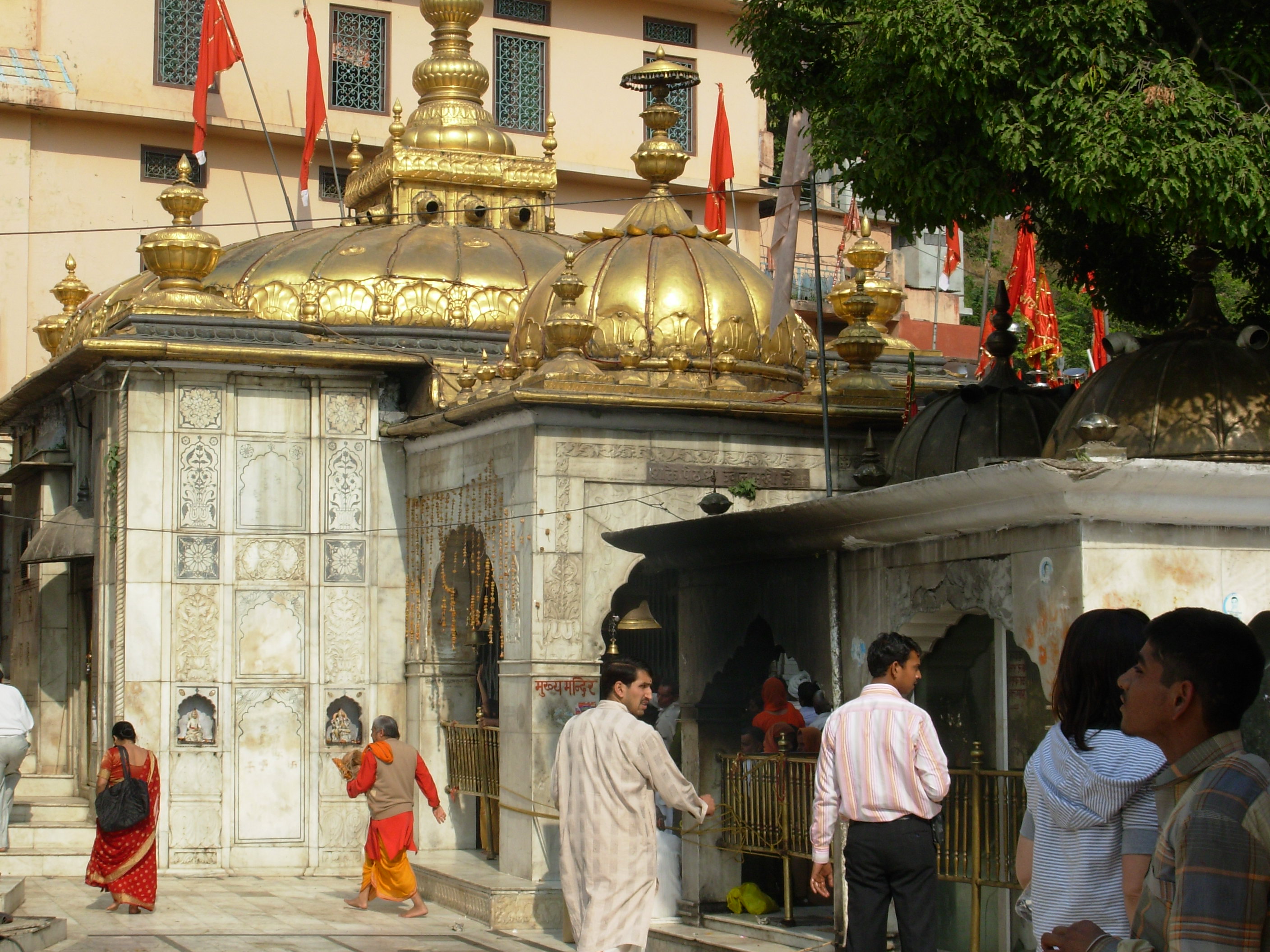
Jwalamukhi Construction History: A Shrine in the Himalayas
Unlike massive stone temple cities of the South, Jwalamukhi is built to blend seamlessly into the dramatic, forested foothills of the Himalayas.
1. Ancient Origins
The site of the eternal flames has been known and worshipped by Himalayan sages for thousands of years. It features prominently in the ancient Hindu epic, the Devi Bhagavata Purana, which details the esoteric significance of the Shakti Peethas. The region of Kangra itself is steeped in deep Tantric and Shakta traditions.
2. The Kangra Architectural Style
The current physical structure overhead is relatively recent, primarily constructed in the 18th century by Raja Bhumi Chand of the Kangra Kingdom. The temple follows traditional Himachali hill-temple architecture. It is built entirely of stone, beautifully carved, and features a traditional wooden mandapa interior. The roof is distinctly styled with an elegant, goldenly painted dome (shikhara) with striking silver interiors.
3. Maharaja Ranjit Singh's Gold
In 1815 CE, the great Sikh ruler Maharaja Ranjit Singh—the 'Lion of Punjab' who famously gilded the Kashi Vishwanath Temple and the Golden Temple of Amritsar—visited Jwalamukhi. Profoundly moved by the spiritual energy, he donated massive amounts of gold, which was used to guild the temple's dome. His son, Kharak Singh, later gifted a pair of beautifully ornate, heavy silver folding doors to the shrine.
4. The Scientific Reality
Geologically, the Kangra Valley sits on a fault line. The "eternal flames" are a rare, naturally occurring geological phenomenon where combustible, natural methane gas seeps up from deeply buried subterranean hydrocarbon deposits through microscopic rock fissures, burning continuously upon encountering atmospheric oxygen. However, for centuries of devotees, this scientific explanation only adds to the magic of the Goddess's divine architecture.
Revealing the Mysteries
Discover the fascinating secrets and divine phenomena of this sacred temple
The Formless Deity: In a rare departure from traditional Hindu temples, the main sanctum has absolutely no idol. The nine eternal flames themselves are worshipped as the physical body of the Goddess.
Sati's Tongue: Revered as one of the 51 Shakti Peethas, this marks the exact spot where the tongue (Jihva) of Goddess Sati is believed to have fallen.
Akbar's Defeat: In the 16th Century, Emperor Akbar famously attempted to extinguish the flames with a heavy iron plate and rushing water, but failed completely.
The Transmuted Canopy: Akbar's arrogant offering of a solid gold canopy was instantly turned into a cheap base metal by the Goddess; the canopy is still on display today.
Maharaja Ranjit Singh's Gold: Following the tradition of royal patronage, the great Sikh Emperor Maharaja Ranjit Singh personally funded the stunning gold-plating of the temple's dome in 1815.
The Nine Goddesses: The nine distinct gas vents are individually worshipped as nine different aspects of the Divine Mother, including Mahakali, Saraswati, and Lakshmi.
Geological Miracle: Scientists have confirmed the flames are naturally occurring methane gas seeps, burning flawlessly from subterranean pockets for perhaps thousands of years.
✨ Each mystery reveals the divine presence within these sacred walls ✨
Explore More Sacred Stories
Discover the legends and mysteries of India's ancient temples
View All Stories