
The Temple
Ekambareswarar Temple in Kanchipuram is one of the five Pancha Bhuta Stalas, where Lord Shiva is worshipped as the Earth (Prithvi) Lingam. The temple's name comes from "Eka" (one) + "Amba" (mango) + "Eswarar" (Lord) — the God who manifested under a single mango tree. What makes this temple extraordinary: the primary Shiva Lingam is NEVER bathed in water! Since it is made of sand (Prithvi/Earth element), water would dissolve it. Instead, only fragrant substances like neem oil, rose water, and sandalwood paste are applied. The bracelet marks and breast imprints of Goddess Parvati are said to be permanently visible on the back of the Lingam — visible even today.

The Sacred Story

The sacred 3500-year-old mango tree — where Parvati fashioned a Lingam from earth and worshipped Shiva
The Complete History of Ekambareswarar Temple, Kanchipuram
THE MISTAKE IN KAILASH
Once on Mount Kailash, Lord Shiva was deep in meditation. Goddess Parvati came from behind and playfully covered his eyes with both her hands. Shiva's eyes are the sun and the moon — the moment they were covered, darkness fell over all creation. All living beings were filled with terror and panic. Shiva immediately opened his third eye to restore light to the world.
However, he told Parvati: "Even though it was in play, this caused harm to the world. To atone for this sin, you must go to Earth and perform severe penance."
THE SAND LINGAM — PARVATI'S PENANCE
Following Shiva's command, Goddess Parvati arrived in Kanchipuram on Earth. On the banks of the river Vegavathi (Kampa river) flowing there, she began penance under a great mango tree. To worship, she took sand/mud from the river bank and fashioned a Shiva Lingam with her own hands. Since it was made of Prithvi (Earth — one of the five elements), it became the "Prithvi Lingam." She installed that Lingam and stood amidst the Five Fires (Pancha Agni) meditating upon Shiva.
THE GREAT FLOOD — SHIVA'S TEST
To reveal Parvati's devotion to the world, Shiva performed a divine act. He suddenly created a terrible flood in the Vegavathi river. The floodwaters rushed rapidly toward the sand Lingam that Parvati had made.
GOD HELD CAPTIVE IN THE EMBRACE (Thazhuvakuzhaindaar)
Parvati was terrified the sand Lingam would dissolve in the flood. Willing even to sacrifice her own life to protect it, she immediately clasped the Lingam tightly to her heart in a firm embrace. Overwhelmed by her immense love and devotion, Lord Shiva himself became permanently established within that sand Lingam.
Because she held him so tightly, her bangles and the marks from her bosom were permanently imprinted on the sand Lingam. Even today, when devotees view the Lingam, those marks are clearly visible on the back. That is why the deity here is called in Tamil "Thazhuvakuzhaindaar" (The God who melted in the embrace).
Lord Shiva then manifested from that Lingam and married Goddess Parvati.
THE 3,500-YEAR-OLD MANGO TREE
In one of the temple's enclosures stands a mango tree (Sthala Vriksha) believed to be approximately 3,500 years old.
• Four Vedas: The four main branches of this tree are symbolic of the four Vedas (Rig, Yajur, Sama, Atharvana Veda). • Four Tastes: The mangoes from this single tree bear four different tastes (sweet, sour, astringent, bitter). This is an unexplained wonder of nature. • Devotees believe that childless couples who receive the fruit of this tree as prasadam will be blessed with children.
Timeless Architecture

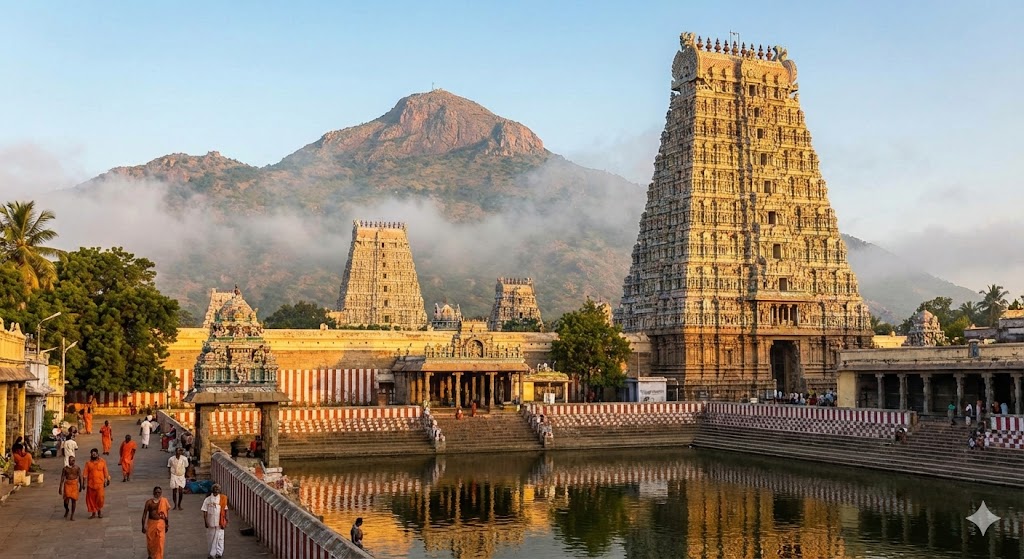
Ekambareswarar Temple has a history spanning over 1,400 years. Originally built in the 6th century CE during the Pallava period, it was expanded by the Chola dynasty and later magnificently reconstructed by Vijayanagara Emperor Krishnadevaraya in the 16th century.
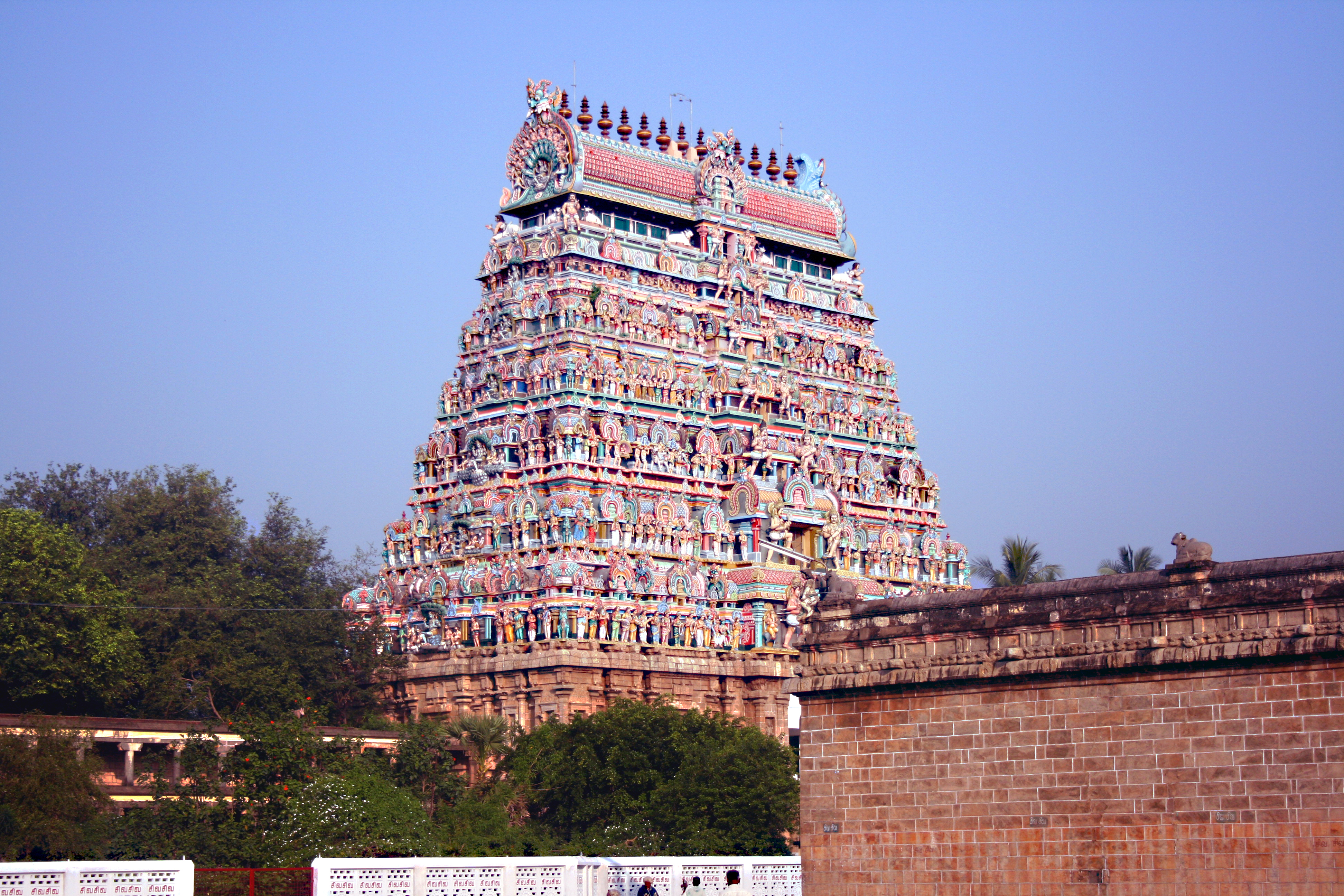
Krishnadevaraya built the towering 192-foot (58-meter) Rajagopuram — one of the tallest temple towers in South India. He also constructed the magnificent Thousand-Pillared Hall (Aayiram Kaal Mandapam) within the complex.
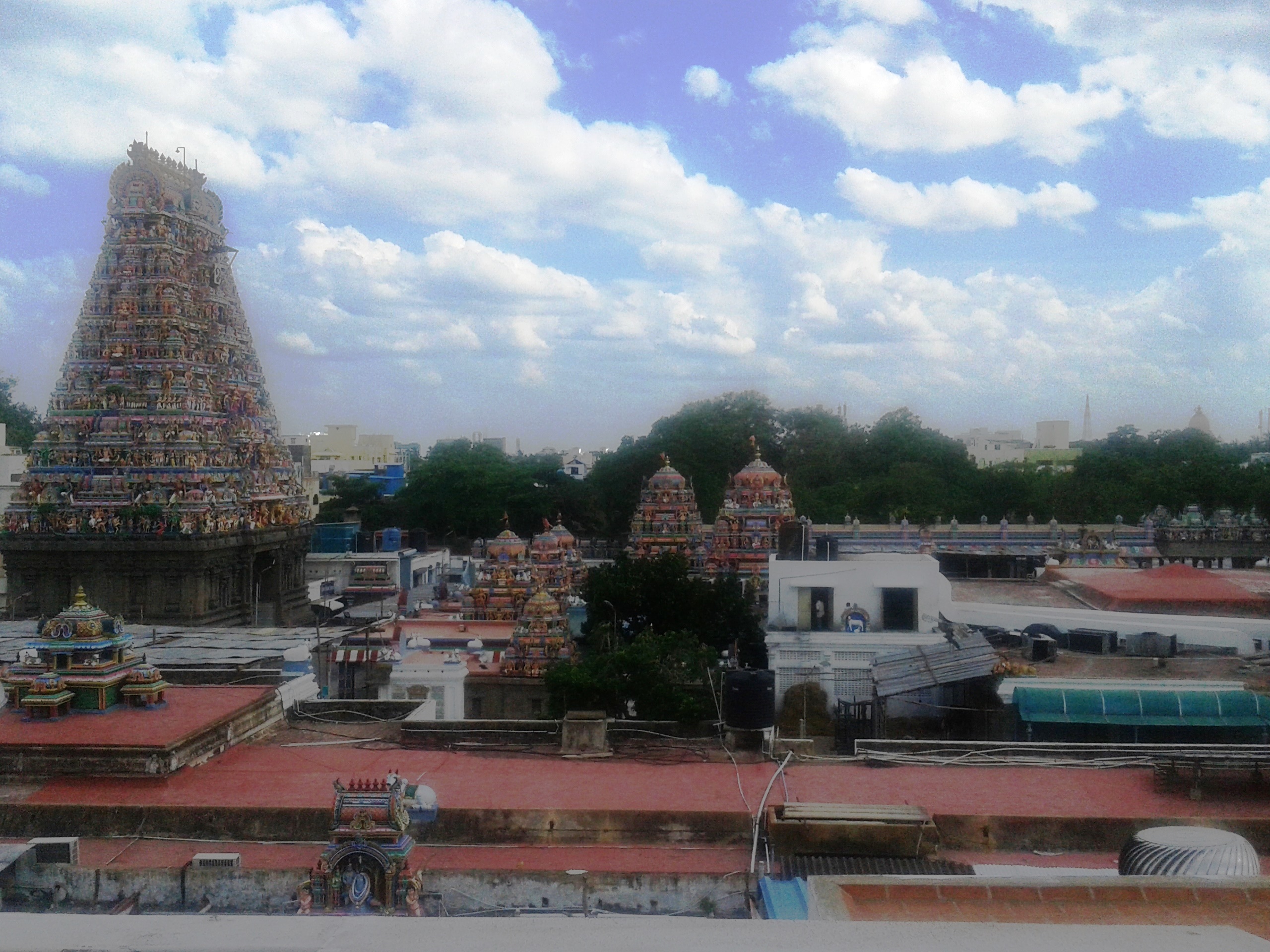
The temple spans 40 acres and has five enclosures, making it one of the largest temple complexes in India.
Revealing the Mysteries
Discover the fascinating secrets and divine phenomena of this sacred temple
Water is NEVER poured on the main Lingam — only rose water, neem oil & sandalwood paste
Parvati's bangle marks and breast imprints are permanently visible on the back of the Lingam
Kamakshi Amman Temple (a separate temple) serves as the Goddess shrine for this entire complex
1,008 Shiva Lingams are carved on a single large Lingam within the temple complex
On Ratha Saptami day (February), sunrays fall directly on the Lingam in the sanctum
The 3,500-year-old mango tree bears four different tastes from its single trunk
192-foot Rajagopuram built by Krishnadevaraya — one of tallest in South India
✨ Each mystery reveals the divine presence within these sacred walls ✨
Complete the Pancha Lingalu Circuit
Each of the five Shiva temples embodies a different element of creation. Explore them all.

Complete Ekambareswarar Temple Guides
Plan Your Visit
Temple timings, dress code, how to reach Kanchipuram, parking, and what to expect at one of South India's largest temple complexes.
The 3,500-Year-Old Mango Tree
The story, science, and spirituality of the ancient mango tree inside Ekambareswarar Temple — one fruit, four tastes.
Ratha Saptami: The Solar Miracle
Every year on Ratha Saptami (February), sunrays enter the temple and fall directly on the Prithvi Lingam — a precise alignment that ancient architects designed into the temple 1,500 years ago.
Kanchipuram: City of 1,000 Temples
Kanchipuram is one of India's seven sacred cities (Sapta Moksha Puris). A complete guide to visiting Kanchipuram beyond Ekambareswarar — temples, silk, food, and history.
Explore More Sacred Stories
Discover the legends and mysteries of India's ancient temples
View All Stories