
The Temple
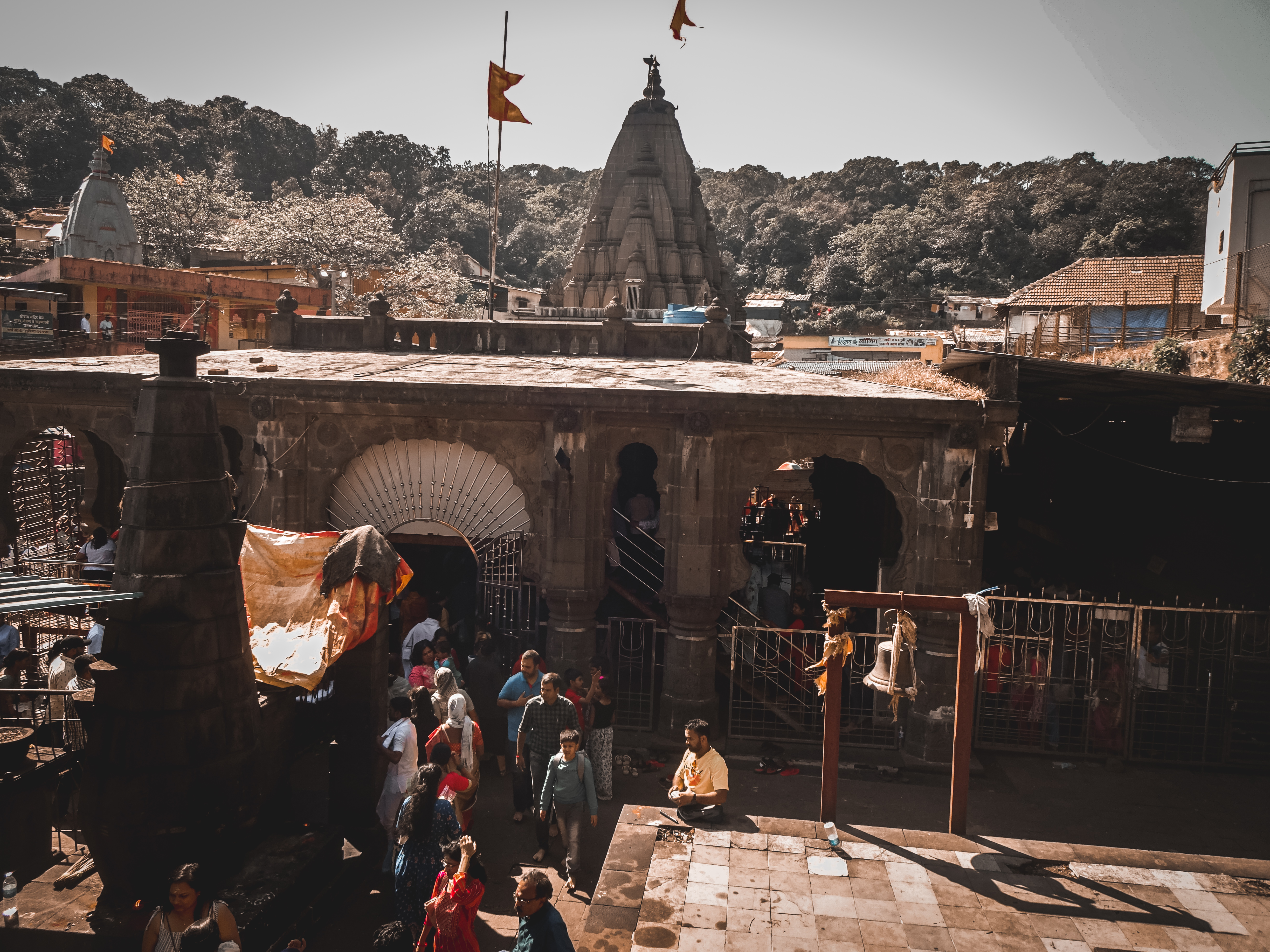
Tryambakeshwar Temple is located near Nashik, Maharashtra, at the foot of Brahmagiri mountain — from where the sacred Godavari River originates. "Tryambaka" means "Three-Eyed" — referring to Lord Shiva who has three eyes. The Lingam here is extraordinary: it has three faces representing Brahma (creator), Vishnu (preserver), and Shiva (destroyer). All three are worshipped in a single stone. Nashik is also one of the four cities where the Kumbh Mela (world's largest human gathering) rotates every 12 years. The Tryambakeshwar Kumbh Mela held on the banks of the Godavari is one of the most sacred.

The Sacred Story

Where the Godavari descends from Brahmagiri — the three-faced Lord of creation, preservation and dissolution
The Epic Legend of Tryambakeshwar: The Descent of Godavari
Tryambakeshwar near Nashik is the 8th Jyotirlinga — where the holy Godavari River originates at Brahmagiri.
Part 1: Mythological Events (Sage Gautama and the Drought)
1. Sage Gautama and the 100-Year Drought
According to the Shiva Purana, the great Sage Gautama and his pious wife Ahilya resided in an ashram on Brahmagiri mountain. Once, a devastating drought struck the earth, lasting a hundred long years. Witnessing the suffering of humans, birds, and animals, Gautama performed rigorous penance to Varuna, the God of oceans and rain. Pleased, Varuna granted him a divine, inexhaustible supply of water and food. Gautama's ashram thus became a haven of abundance, attracting sages from all over the country.
2. The Jealousy and the Illusionary Cow
However, this newfound prosperity and Gautama's rising fame caused intense jealousy among the other sages. They conspired to ruin him by sending a weak, magical cow (some texts say it was Goddess Parvati's friend Jaya in disguise) into Gautama's grain field.
When Gautama gently tried to shoo the cow away with a mere blade of Darbha grass, the frail illusionary cow instantly fell dead. The jealous sages immediately cried out, accusing him of "Gohatya" (the grave sin of killing a cow) and demanded he leave the ashram in disgrace.
3. The Penance for Purification
To cleanse himself of this terrible sin, Gautama left his home and performed agonizing penance to Lord Shiva on the Brahmagiri peak for a thousand years. Deeply moved by his sincere devotion, Lord Shiva appeared and revealed the deceit of the jealous sages. Though Shiva declared Gautama innocent, the sage insisted on being purified and begged Shiva to bring the holy River Ganges down to earth.
4. The Birth of the Godavari River
Lord Shiva commanded Goddess Ganga to descend. Ganga agreed but placed a condition: she would flow there only if Lord Shiva himself resided at that location permanently. Shiva consented. Ganga descended onto Brahmagiri and flowed as the sacred Godavari River (also known as Gautami Ganga in honor of the sage).
True to his word, Lord Shiva took the form of the glorious Tryambakeshwar Jyotirlinga, residing at the source of the river to bless and protect the world.
Timeless Architecture

Tryambakeshwar Construction History: The Peshwa's Masterpiece
The Tryambakeshwar Temple as it stands today is a brilliant showcase of Maratha architecture and patronage.
1. Ancient Origins
While the Jyotirlinga and the sacred geography of Brahmagiri have been revered since the Puranic age, the original shrines were likely modest structures. The site has always been a major pilgrimage center, especially noted for its connection to the Kumbh Mela dating back thousands of years.
2. Construction by Peshwa Nanasaheb (1755 CE)
The magnificent current temple complex was commissioned by the Maratha ruler, Peshwa Nanasaheb (Balaji Baji Rao I). Construction began in 1755 CE and took several decades to complete. It is built entirely of beautifully carved black basalt stone found locally in the region.
3. Hemadpanthi-Nagara Architecture
The temple is an excellent example of the later Hemadpanthi style blended with Nagara (North Indian) architectural elements. The main Shikhara (tower) rises majestically to about 25 meters (82 feet) and is topped by a golden Kalash (pitcher) and a prominent Trident (Trishul). The entire structure sits within a spacious courtyard surrounded by high stone walls.
4. The sacred Kushavarta Kund
A short distance from the main temple is the Kushavarta Kund (a large holy pond). It was built by Shrimant Sardar Raosaheb Parnerkar, the Fadnavis of Indore state. This Kund is considered the symbolic source of the Godavari river where it emerges after disappearing underground from the Brahmagiri hills. It is here that the sadhus take their primary holy dip (Shahi Snan) during the Kumbh Mela.
Revealing the Mysteries
Discover the fascinating secrets and divine phenomena of this sacred temple
The Three-Faced Jyotirlinga: Unlike any other Jyotirlinga, the Lingam here is actually a depression in the floor containing three thumb-sized faces representing the Hindu Trinity: Lord Brahma, Lord Vishnu, and Lord Mahesh (Shiva).
The Jeweled Crown: The three faces of the Lingam are covered by an exquisite, ancient crown encrusted with diamonds, emeralds, and pearls, believed to have been bestowed during the age of the Pandavas.
Origin of India's Second Longest River: The temple sits at the exact source of the Godavari River (the Ganges of the South), which flows out from the Brahmagiri hills.
Eroding Lingam: It is believed that the continuous flow of water over the Tryambakeshwar Lingam is slowly eroding the stone, a phenomenon said to symbolize the spiritual erosion taking place in the current Kali Yuga.
Kumbh Mela: Nashik is one of the four prestigious locations for the Kumbh Mela. When Jupiter enters Leo and the Sun enters Aries, millions gather here for the sacred Simhastha Kumbh Mela.
Panchavati: Close to this temple in Nashik is Panchavati, the famous forest where Lord Rama, Sita, and Lakshmana spent a significant portion of their 14-year exile.
✨ Each mystery reveals the divine presence within these sacred walls ✨
Explore All 12 Jyotirlingas
Twelve temples of divine light, spread across India — each a self-manifested Shiva Lingam.




← Swipe to see more →
Explore More Sacred Stories
Discover the legends and mysteries of India's ancient temples
View All Stories